




Science Party Games for Kids and Teens: 7 Easy Ideas That Actually Keep Them Engaged
A science party sounds great in theory. Then you start planning and realize that watching someone else make a volcano erupt probably won’t keep a group of 12-year-olds entertained for two hours.
The trick is to choose activities where the kids actually have something to solve, test, build or figure out.
You also don’t need seven complicated experiments running at the same time. A few well-chosen science party games can give the party structure without making it feel like another day at school.
Here are seven ideas that work especially well for older kids and teens.
1. Mystery Substance Challenge
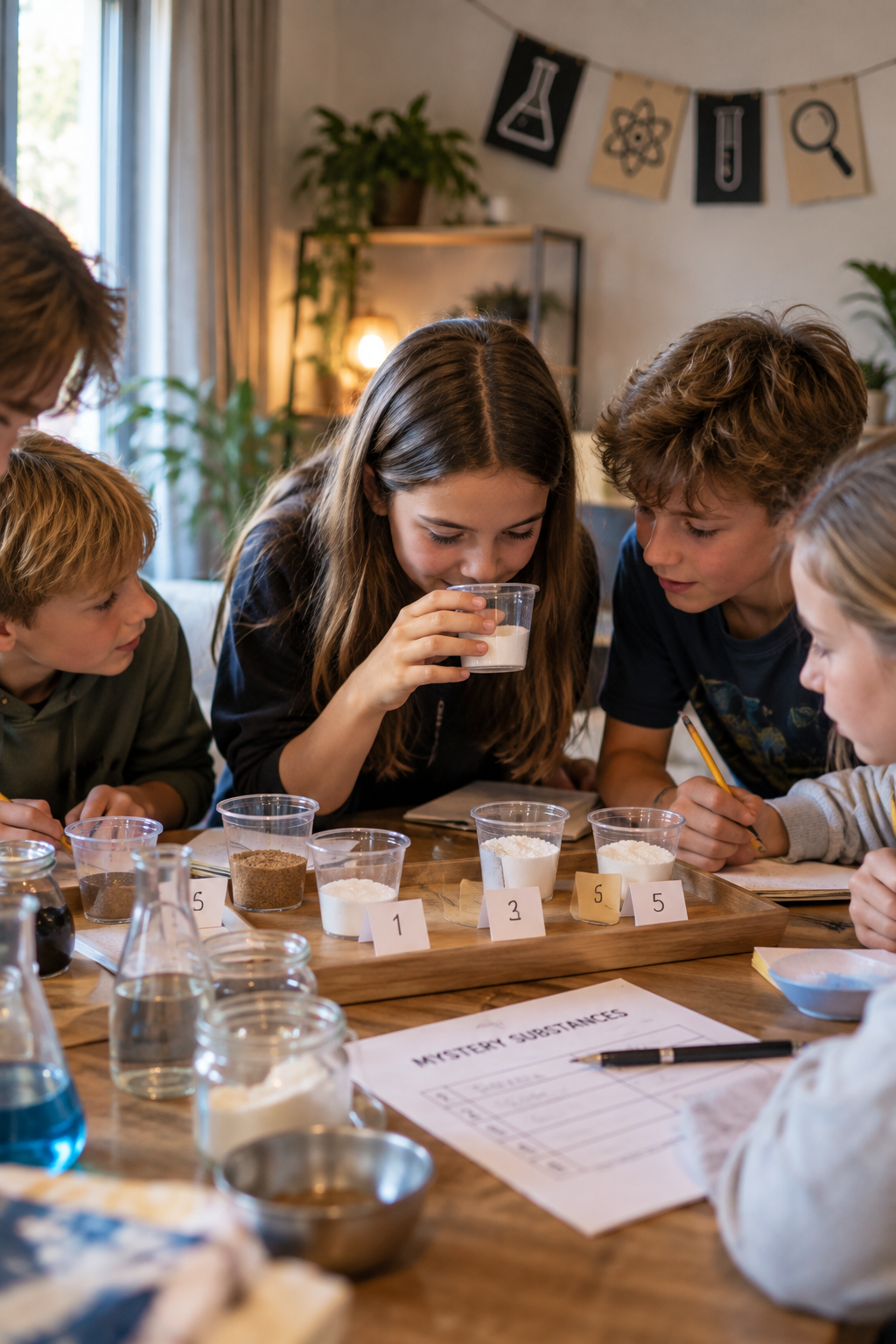
Set out several numbered cups containing safe household ingredients such as sugar, salt, flour, baking soda and cornstarch.
The challenge is to identify each mystery substance without simply tasting everything.
Give teams a few tools and clues. They might examine texture, smell the samples, add water or test how each substance reacts to vinegar.
Let them write down their guesses before revealing the answers.
Make it more interesting: Include one or two substances that look almost identical so observation alone isn’t enough.
Best for: ages 9–14 and small teams.
2. Fingerprint Investigation
Fingerprinting is easy to set up but still feels like real detective work.
Have everyone make a fingerprint using a washable ink pad. Then let them compare loops, arches and whorls using magnifying glasses.
For the game itself, prepare a few anonymous prints and ask players to work out which person each one belongs to.
You can turn it into a mini investigation by adding a story:
A mysterious note was found in the laboratory. One fingerprint was left behind. Who touched it?
Suddenly a five-minute science activity becomes a case.
Tip: Keep the number of suspects small. Comparing twenty fingerprints stops being fun surprisingly quickly.
3. Crack the Secret Code
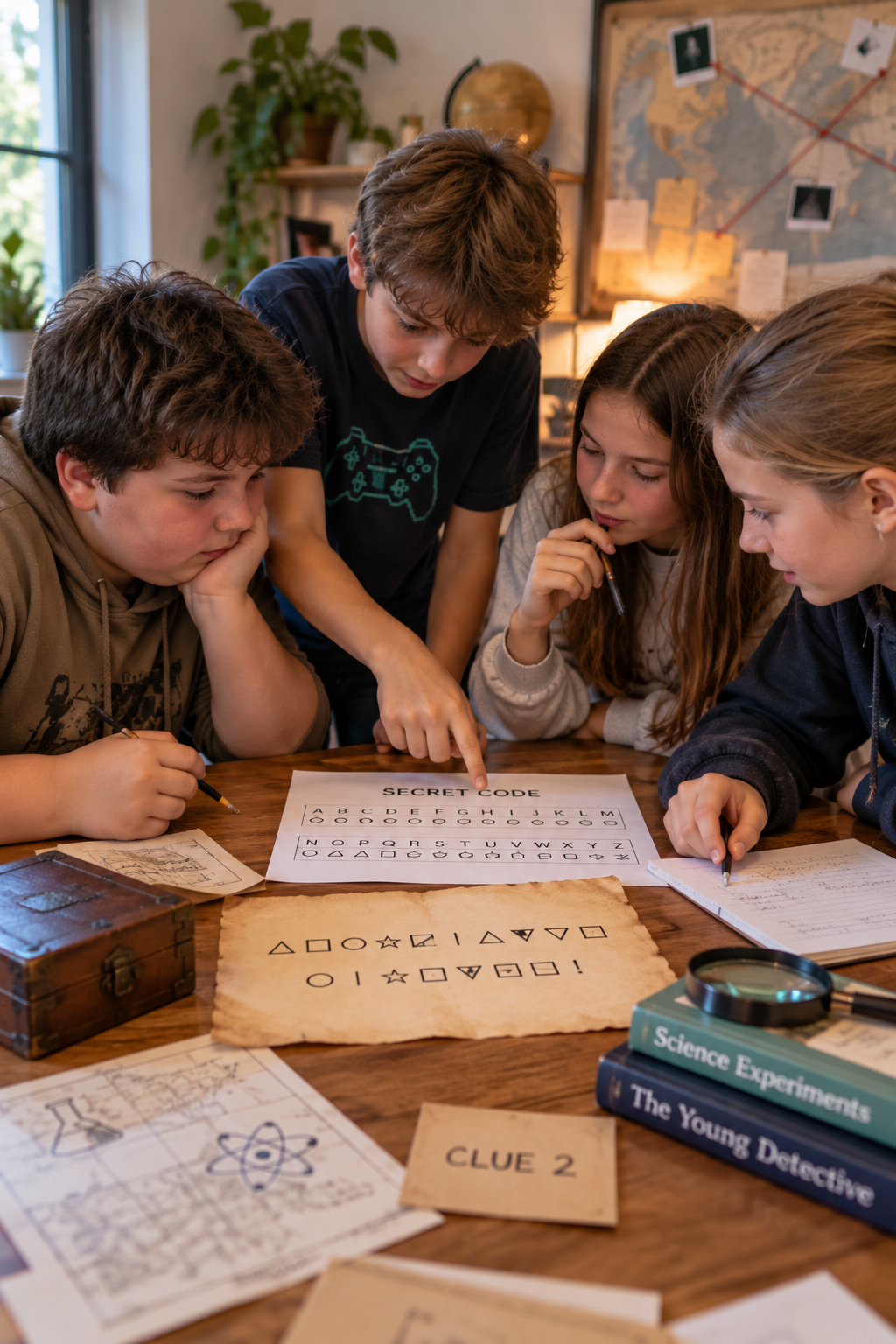
Give players an encoded message that reveals the location of the next clue.
A simple substitution cipher works perfectly. For younger players, provide the complete key. For teens, give them only part of it and let them work out the rest.
The decoded message could say:
CHECK UNDER THE BLUE CHAIR
or:
THE NEXT CLUE IS WHERE THINGS STAY COLD
Hide another clue at the location and you’ve created a short science-themed investigation with almost no preparation.
Best for: kids who like puzzles more than messy experiments.
4. Build the Strongest Structure
Give every team the same materials—straws, tape, paper, spaghetti, marshmallows or wooden sticks—and one clear objective.
For example:
- Build the tallest free-standing tower.
- Build a bridge that can hold a book.
- Protect an egg from a short drop.
- Build something that can support a cup of water.
Set a time limit of around 15–20 minutes.
The competition is fun, but the best part usually happens halfway through when someone’s brilliant engineering plan starts leaning dangerously to one side.
Afterward, ask each team what they would change if they had another attempt.
Keep it manageable: Pick one challenge, not four.
5. Evidence Scavenger Hunt
Instead of a normal scavenger hunt, make every item part of a scientific investigation.
Hide evidence around the party space and give players a list of things they need to locate, such as:
- a coded message
- a fingerprint
- an unknown powder sample
- a torn photograph
- a measurement
- a suspicious laboratory note
Each piece of evidence should tell them something—or at least make them think it does.
You can have teams collect everything first and then sit down together to decide what happened.
For older kids: Add a few red herrings. Not every piece of evidence needs to matter.
6. The Five-Minute Experiment Challenge
Prepare three or four very short experiments and let small groups rotate between them.
Keep each station simple enough that players can understand what to do without an adult explaining it for ten minutes.
Good options include:
- testing which objects sink or float
- creating a simple density tower
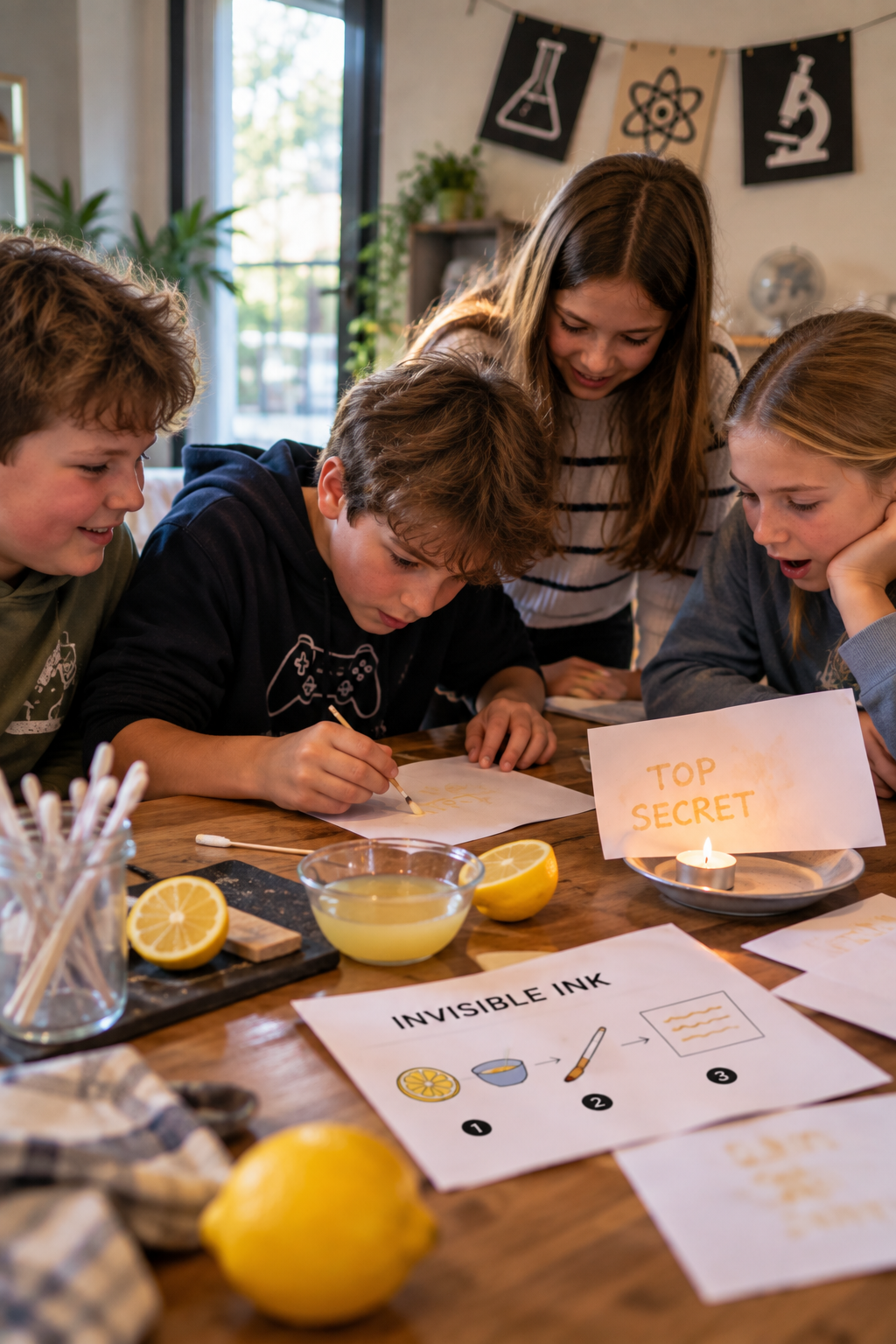
- making invisible ink
- testing acids and bases using a safe indicator
- predicting which material makes the best paper airplane
Before each test, players must write down their prediction.
That small step makes the activity much more interesting because now they have something to prove—or discover they were completely wrong about.
Important: Choose experiments that can be reset quickly between groups.
7. Solve a Full Science Mystery
If you want one activity to carry most of the party, turn the entire event into an investigation.
Give each guest a character, introduce a suspicious event and let players uncover information through conversations, clues and evidence.
A science setting works particularly well because unusual experiments, missing research, laboratory accidents and competing scientists already give you plenty of reasons for secrets and suspicious behaviour.
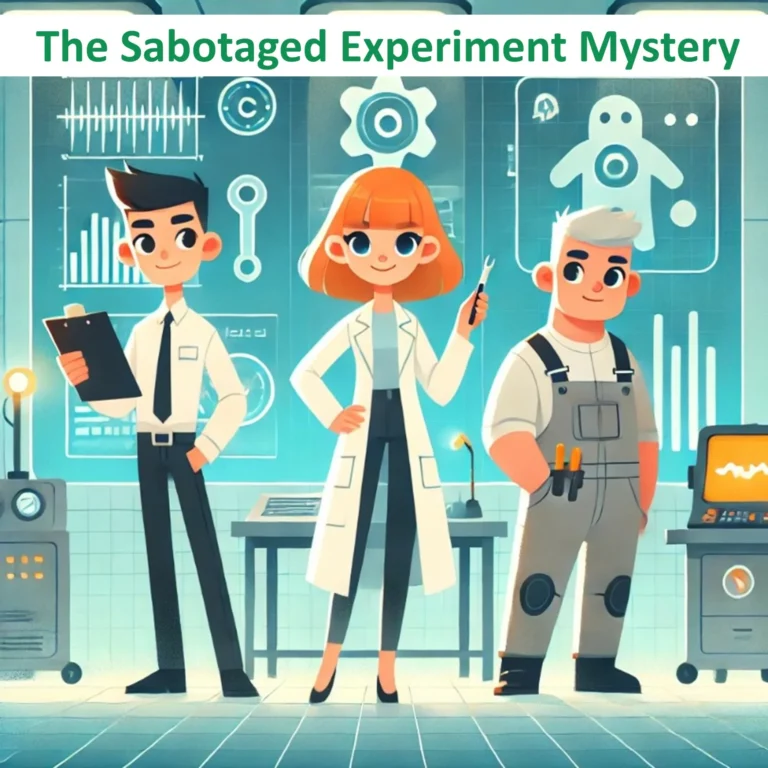
Our The Sabotaged Experiment Mystery was created around exactly this idea: rather than moving from one unrelated party activity to another, players become part of the story and have to work out what really happened.
This works especially well with older kids and teens because they aren’t being asked to play a children’s game. They’re solving a case.
Don’t Try to Fill Every Minute
One of the easiest mistakes when planning a kids’ or teen party is assuming you need constant organised entertainment.
You don’t.
Choose two or three shorter science party games, add food and free time, and use one bigger activity as the centre of the party.
For example:
Arrival: Fingerprint investigation
First activity: Mystery substance challenge
Food break
Main event: Science mystery game
End: Cake, snacks and comparing theories
That’s already a full party.
And if the kids are still debating who tampered with the experiment while their parents are arriving to pick them up?
That’s usually a pretty good sign you chose the right activity.